
Tattoo Connection Journal
Half Sleeve Tattoo Ideas That Feel Complete
A good half sleeve has a clear point of view, room for the body to move, and enough breathing space for the important images to stay important.

Half sleeve tattoo ideas can pile up fast. You save a flower, a skull, a bird, a portrait, a quote, then discover that every one of them looks different when it has to share the same arm. The solution is not to find the most ideas. It is to choose a direction before the best placement gets used by a design that does not belong there.
A half sleeve gives an artist enough room to build rhythm without asking you to commit to an entire arm at once. It can run from shoulder to elbow or from elbow to wrist. Either way, it is a living surface, not a flat sketchbook page. The elbow bends, the forearm turns, and the inside of the arm appears and disappears as you move. Planning for those changes is what makes a sleeve feel deliberate from every angle.
Choose the part of the arm first
An upper-arm half sleeve is a strong choice for a broad, rounded design. It can carry a large animal, floral composition, portrait, or bold central symbol that needs room around it. It also gives you a natural stopping point at the elbow if you want the option of extending downward later. A lower-arm half sleeve is more visible day to day and suits designs that can travel with the forearm, such as a long flower stem, animal, snake, ornamental pattern, or connected collection of smaller tattoos.
Think about how you want the tattoo to show up in real life. Do you want it to appear in a short sleeve, sit mostly under a shirt, or be part of the way you use your hands and gestures? None of those answers is better. They simply change what placement will feel right. The gallery is useful for seeing how tattoo work changes when it wraps around a shoulder, follows an outer forearm, or uses the elbow as a natural break.
Do not choose the area only because it looks empty. Choose it because the shape serves the image. A wide, calm subject needs a different canvas than a narrow design with a clear direction. When in doubt, tell the artist which areas you are considering and let the drawing lead the final choice.

Pick a visual direction, not a random pile
A half sleeve does not need one literal theme. It does need a visual idea that helps every later decision. That may be a style, such as American traditional, black and gray realism, blackwork, ornamental work, or botanical illustration. It may be a mood, such as bright and playful, dark and dramatic, quiet and natural, or loud and graphic. It may be a personal thread, such as family, music, animals, travel, or a place that matters to you.
The goal is not to make every image match perfectly. A sleeve becomes more personal when a few unexpected details are allowed in. What keeps it together is shared line weight, a related color approach, compatible scale, or a clear path for the eye to follow. Tattoo flash has long used instantly recognizable silhouettes because an image that reads quickly has a better chance of holding its place beside other work. The Smithsonian’s account of the Lyle Tuttle tattoo art collection explains how flash designs were displayed to show an artist’s style and attract clients.
Make a small reference set before your consultation. Include examples of the linework, contrast, color, and overall feeling you like. Then add a separate list of subjects that matter to you. Separating style from subject helps an artist understand what needs to stay true and what can be translated into a stronger tattoo drawing.
Give one or two designs the lead role
Every convincing half sleeve has a hierarchy. Pick the images that deserve the most space and attention, then let the supporting pieces earn their places around them. A large flower, animal, face, sacred heart, landscape, or personal symbol can become the anchor. An anchor does not have to be the biggest tattoo on the arm, but it should be the image that tells the viewer where to look first.
Placing anchors early protects the best real estate. It is frustrating to add several small tattoos and then find that the only room left for the image you truly care about is narrow, broken up, or stuck against the elbow. Start with the design that needs the most room. The smaller tattoos can later bridge a gap, repeat a color, or soften an edge without competing for the same spotlight.
If your idea is American traditional, the shop’s American traditional sleeve guide goes deeper on choosing those anchors before the filler. The principle works in any style: give the strongest idea the clearest place to live.

Decide whether you want one composition or a collected sleeve
There are two honest ways to build a half sleeve. A single composition treats the arm as one connected scene. The artist plans the main subject, background, transitions, and negative space together. This approach is useful when your concept is already clear, such as a botanical arm, a single animal scene, a portrait with supporting elements, or a large ornamental design. It can feel seamless because every section is designed to belong.
A collected or patchwork sleeve builds through separate tattoos. Each image can stand on its own, but scale, spacing, and a few shared choices keep the arm from feeling accidental. This approach gives you time to collect symbols, memories, and designs without pretending you know every future tattoo today. It asks for restraint: the gaps matter, and not every empty spot needs a tiny tattoo immediately.
Neither approach is more serious or more meaningful. The wrong choice is trying to force a patchwork collection into a continuous background after the best spaces are already crowded, or treating a large single composition as a set of unrelated sketches. Tell the artist which route feels more like you. That one sentence can guide the design from the first session.
Use movement and negative space on purpose
A half sleeve should make sense when your arm is straight, bent, relaxed, and turned. Long elements such as stems, branches, snakes, smoke, feathers, or ribbons can guide the eye around a curve. A rounded design can sit comfortably on the shoulder or outer bicep. On the lower arm, a vertical shape may travel well, while the inner forearm can suit a more personal detail that is not meant to read from across the room.
Open skin is not wasted space. It gives the eye a place to rest, protects the outline of a larger tattoo, and leaves you options if the arm grows later. That matters especially near the elbow, where the skin bends and designs can become visually busy. A thoughtful sleeve often looks more complete because it did not try to fill every inch.
Before you book, take front, back, and side photos of your arm in natural light. Include any tattoos that are already there. Those photos help an artist see the spaces that disappear when the arm turns, the designs that need room, and the points where a new piece can create a cleaner flow.
Let color, contrast, and scale connect the pieces
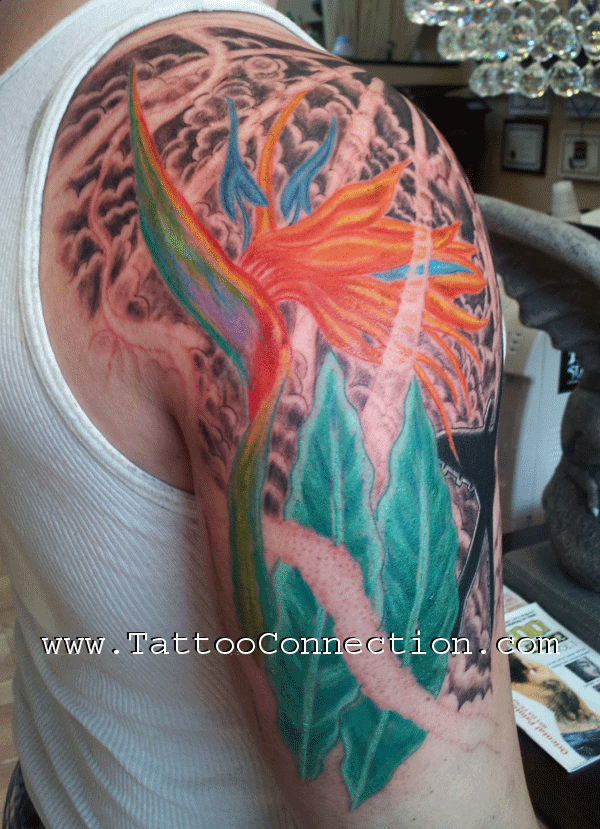
Connection does not require every tattoo to use the same colors. It does require balance. If one section is heavy with dark ink, the next may need open skin, lighter shading, or a cleaner outline. If your anchors use a small group of colors, repeating one or two of them in another tattoo can make the arm feel joined without making it uniform.
Scale matters just as much. A collection of medium-sized tattoos can feel steady. One tiny tattoo beside one very large piece may need a bridge between them, or the small design may simply need more room around it. The artist can adjust a design’s detail and silhouette so it reads at the right distance. That is not a compromise, it is the difference between an image that works on paper and one that works on skin.
If you are filling gaps around traditional work, use the traditional tattoo filler ideas guide to think about the actual shape of each opening before you choose a motif. A small tattoo is more useful when it carries movement or balance, not when it merely takes up room.
Bring a better starting point to the consultation
You do not need a finished sleeve drawing before you contact the shop. You do need a useful starting point. Bring a short list of must-have subjects, a few references that show the feeling you want, and clear photos of the arm. Mark what is already tattooed, what must stay, and whether you want to leave a path open toward a full sleeve later.
At Tattoo Connection, you can look through the artist portfolios to find work that speaks to you, then use a consultation request to start the conversation. If your idea is simple and ready to go, walk-ins are welcome when an artist is available. For a half sleeve, a little planning makes the next session more useful because the design starts with the whole arm in mind.
The best half sleeve tattoo ideas are the ones you can explain in a few honest sentences: what you want to feel, what images matter, what part of the arm you want to use, and whether the piece may grow later. Start there. The artist can turn the direction into a tattoo that looks complete now and still leaves room for whatever comes next.
Frequently asked questions
What counts as a half sleeve tattoo?
A half sleeve usually covers either the upper arm from shoulder to elbow or the lower arm from elbow to wrist. The more useful question is whether the tattoos are planned to work together as the arm moves, rather than simply how much skin is covered.
Should I choose one large design or several tattoos?
Either can work. One composition can feel immersive and connected, while a patchwork sleeve lets separate meaningful tattoos build over time. Choose the approach that fits the imagery you want and tell the artist whether you may expand later.
Can I turn existing tattoos into a half sleeve?
Often, yes. Start with clear photos of the whole arm. An artist can assess the existing tattoos, the open space, and whether the strongest route is to connect them, add a few supporting pieces, or keep a deliberate patchwork layout.
What should I bring to a half sleeve consultation?
Bring a short list of subjects or memories that matter, a few references for the style and color you like, and photos of the arm from several angles. It also helps to explain what you want to keep open for a future full sleeve.


